
Learning Center
Air Conditioning
What Is Air Conditioning?
Air conditioning (AC) is the process of removing heat and moisture from indoor air to improve comfort. While most people associate it with cooling, modern systems can also heat, filter, and dehumidify air.

The Basic Principle: Heat Transfer
Air conditioners don’t “create cold.” Instead, they move heat from inside your home to the outside.
Think of it like this:
-
Heat naturally flows from warmer areas to cooler ones.
-
An AC system forces this process using a special fluid called a refrigerant.
Key Components of an AC System
Most air conditioners (especially central AC systems) have four main parts:
1. Evaporator Coil (Indoor Unit)
-
Located inside your home
-
Absorbs heat from indoor air
-
Refrigerant inside the coil evaporates (turns from liquid to gas), taking heat with it
2. Compressor
-
Located in the outdoor unit
-
Compresses the refrigerant gas, raising its temperature and pressure
3. Condenser Coil (Outdoor Unit)
-
Releases the heat outside
-
The refrigerant cools and condenses back into a liquid
4. Metering Device
-
Reduces the pressure of the refrigerant
-
Prepares it to absorb heat again in the evaporator
This cycle repeats continuously while the AC is running.

EVAP Coil

Compressor

Condenser Coil

Metering Device
This one is an EEV

The Cooling Cycle (Step-by-Step)
-
Warm indoor air is pulled into the system.
-
Air passes over the cold evaporator coil, where heat is absorbed.
-
The cooled air is blown back into the room.
-
The absorbed heat is carried outside by the refrigerant.
-
Heat is released outdoors through the condenser.
-
The refrigerant resets and the cycle repeats.
What About Humidity?
Air conditioners also remove moisture from the air. When warm air hits the cold evaporator coil:
-
Water vapor condenses into liquid (like droplets on a cold drink)
-
This moisture drains away
This is why AC makes rooms feel more comfortable—not just cooler, but less humid.



Types of Air Conditioning Systems
Central Air Conditioning
Package units and Split systems
-
Cools entire home
-
Uses ductwork to distribute air
-
Can usually heat and cool
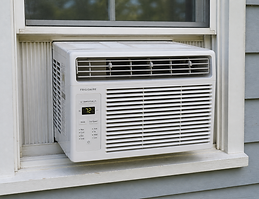
Window Units
-
Compact systems for single rooms
-
All components in one box
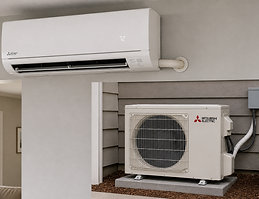
Mini-Splits
-
Small scale split systems
-
Usually no ducting required
-
Typically only cools one room
-
Can usually heat and cool
Portable AC Units
-
Good for temporary cooling
-
Movable units with an exhaust hose

Top left - Package Unit
Top Right - Split System
Middle Left - Window Unit
Bottom Left - Portable Unit
Bottom Right - Mini Split
Energy Efficiency
Air conditioners can use a lot of electricity, so efficiency matters. It’s measured by ratings like:
-
SEER (Seasonal Energy Efficiency Ratio)
Higher SEER = more efficient system
Ways to improve efficiency:
-
Proper insulation
-
Regular maintenance (clean filters, coils)
-
Smart thermostat use
-
Sealing air leaks


Common Misconceptions
-
“Lower thermostat = faster cooling”
Not true. AC systems cool at a fixed rate. -
“AC creates cold air”
It removes heat. It doesn’t generate cold. -
“Bigger AC is better”
Oversized units cycle on/off too often and reduce efficiency.
Why Air Conditioning Matters
Beyond comfort, air conditioning:
-
Improves indoor air quality
-
Prevents heat-related illnesses
-
Protects electronics and materials from humidity damage
-
Supports productivity in homes and workplaces

Final Thoughts
Air conditioning is a clever application of physics, specifically heat transfer and phase changes. By continuously cycling refrigerant through compression and expansion, AC systems efficiently move heat out of your living space, keeping you cool and comfortable even in extreme weather.